Parc de Champagne in Reims: history, heritage and things to do
22 hectares of lawns, tree-lined paths and woodland on the Colline Saint-Nicaise, in southeast Reims, right above the Pommery cellars. Parc de Champagne, known as Parc Pommery until 2004, is the city’s largest green space. Entry is free and opening hours change with the seasons: 7:30 AM to 9 PM from June to September 2026, usually 9 AM to 5 PM in winter (details below). Locals come here to run, picnic, walk the dog, bring the kids. Visitors often end up here after a cellar tour, walking uphill into daylight. The park also carries a layered history: a champagne mogul who built a garden for his workers in 1911, a sports pioneer who founded France’s first athletic training centre here in 1913, and a monument destroyed by the Nazis in 1940, then rebuilt seventy-three years later.
Parc de Champagne opening hours
The City of Reims sets the park’s opening hours month by month, depending on the season and events. Here are the latest known hours as of 30 September 2026:
| Period | Hours | Source |
|---|---|---|
| June to September 2026 | 7:30 AM to 9 PM, except closure days | City of Reims |
| October 2026 | 9 AM to 8 PM | Reims Tourist Office (the City had not yet published its October hours as of 30 September) |
| Low season, November to March | Usually 9 AM to 5 PM | Hours from previous winters |
When is the park closed?
The park closes on certain days to prepare for or host an event. In 2026, for example, it was closed from 13 to 17 July and from 19 to 21 July around the Flâneries Musicales picnic concert, then on 24, 25 and 31 August around Festiv’été, which cut opening hours to noon to 8 PM from 26 to 30 August. Like all parks in Reims, it also closes when a severe wind or storm warning is issued.
Before you go, check the park’s page on reims.fr (in French), which publishes the month’s schedule. The City also runs a park newsletter covering openings, closures, events and works.
At a glance
| Info | Details |
|---|---|
| Area | 22 hectares (21.6 ha) |
| Address | 10 avenue du Général Giraud, 51100 Reims |
| Hours | Seasonal: 7:30 AM to 9 PM from June to September 2026, usually 9 AM to 5 PM in winter (details) |
| Admission | Free |
| Parking | Free, accessible from avenue du Général Giraud |
| Bus | Line U5, “Parc” stop |
| Labels | Historic Monument (2004), Jardin remarquable (2014) |
| Style | English landscape garden |
| Trees | About 3,000 |
| Visitors | Over 350,000 per year |
| Contact | +33 3 26 35 52 50 / rf.smier@engapmahcedcrap |
From Pommery to Parc de Champagne
It all starts with a marquis. In 1907, Melchior de Polignac, grandson of the famous Veuve Pommery and head of the champagne house, decided to build a large park for his employees. The site sits on the heights of Reims, chalky and stony ground, directly above the Pommery cellars. The goal: give workers and their families a place to relax.
Polignac hired Édouard Redont, a Reims-born landscape architect already well known across Europe (more on him below). Construction began in 1909. The park opened in 1911 to workers and their families. No other company in France did anything like this at the time: a 22-hectare park made available to its staff.
On 19 October 1913, President Raymond Poincaré came to inaugurate the park, then called Parc Pommery. But Polignac already had another project in mind.
The Collège d’athlètes
Context: in 1912, France performed poorly at the Stockholm Olympics. A group of scientists, doctors and athletes signed a manifesto to create the Collège d’athlètes de Reims, a training centre for sports teachers and Olympic athletes. Polignac lent the park. Georges Hébert, a naval officer, took over as technical director in 1913.
The Hébert method relies on ten families of movement: walking, running, jumping, climbing, lifting, throwing, swimming, self-defence, balancing and carrying. Nothing like the rigid military gymnastics of the time. Parc Pommery became France’s first athletic training centre, a forerunner of today’s INSEP.
Jean Bouin, world record holder in the 10,000 metres, trained here. On 23 July 1912, the park hosted the American Olympic delegation returning from Stockholm (the top nation in athletics medals that year).
The experiment lasted eighteen months. World War I put a stop to it. But the Hébert method, known as hébertisme, shaped French physical education for decades and opened sport to women. A memorial stele to Hébert still stands in the park.
Édouard Redont, the landscape architect
Redont (1862-1942) was born in Champigny-sur-Vesle, in the Marne département. His father was a washer, his mother a laundress. He became one of the most sought-after landscape architects of his era. In 1900, he won the gold medal at the Paris World’s Fair for his design of the Bibesco Park in Craiova, Romania (now Nicolae Romanescu Park).
In Reims, Redont designed Parc de Champagne, the Parc de la Patte-d’Oie and the Pierre Schneiter horticultural garden. His conviction: plantings cleanse the soil, purify the air, filter dust. He often quoted an old Roman saying, “floris fauna non sine” (no fauna without flora).
On the chalky ground of the Colline Saint-Nicaise, Redont laid out an English-style garden with winding paths and varied plantings. His contemporaries considered the result the finest sporting and landscape park in France. In 1911, he also co-founded the French Society of Urbanists with Henri Prost.
The wars
Between 1914 and 1918, Reims was bombed continuously. The park, on the heights, took a direct hit. Trees, Collège d’athlètes buildings, landscaped areas: almost everything was destroyed.
In 1922, Redont and architect Ernest Kalas rebuilt the park. Around 3,000 trees were replanted. The park returned to its role as a place for walking and sport for the people of Reims.
World War II affected the park differently. In September 1940, German troops destroyed the monument to the heroes of the Armée noire, which stood at the corner of boulevard Henri-Vasnier and avenue du Général-Giraud, facing the entrance. This bronze, unveiled in 1924, honoured African colonial soldiers who fought in World War I. The Nazis would not tolerate the symbol.
Heritage labels
2004: the park’s historic remains were listed as a Historic Monument. The same year, LVMH (owner of Pommery) handed the park to the City of Reims, which has managed maintenance and events since.
2014: the park received the “Jardin remarquable” label from the French Ministry of Culture. Two other Reims gardens designed by Redont (the Pierre Schneiter garden and the Patte-d’Oie) received the same label that year.
The Colline Saint-Nicaise is part of the core zone of the “Champagne Hillsides, Houses and Cellars”, a UNESCO World Heritage Site since 2015. The Pommery, Ruinart, Taittinger and Veuve Clicquot cellars are carved into the chalk beneath this same hill, in galleries dating back to the 3rd century. The park is a 10-minute walk from the Pommery, Ruinart or Taittinger cellars.
Monuments in the park
The monument to the heroes of the Armée noire
This is the most historically charged work in the park. Sculptor Paul Moreau-Vauthier and architect Auguste Bluysen designed the original, unveiled on 13 July 1924 before some 15,000 people. The pedestal is made of granite brought from Africa, shaped like a tata (a West African fortification). The names of the battles in which African troops fought are engraved on it. At the top, a bronze group: four Senegalese tirailleurs around a French officer holding the flag. An identical monument exists in Bamako, Mali.
Destroyed in September 1940 by the Nazis, the monument was recreated in 2013 from the original plans. It was placed in an alley of the park, not at its former location. On 6 November 2018, President Emmanuel Macron inaugurated the new monument alongside Malian President Ibrahim Boubacar Keïta.
The sports clubs memorial
A memorial to members of Reims sports clubs killed during World War I.
The Georges Hébert stele
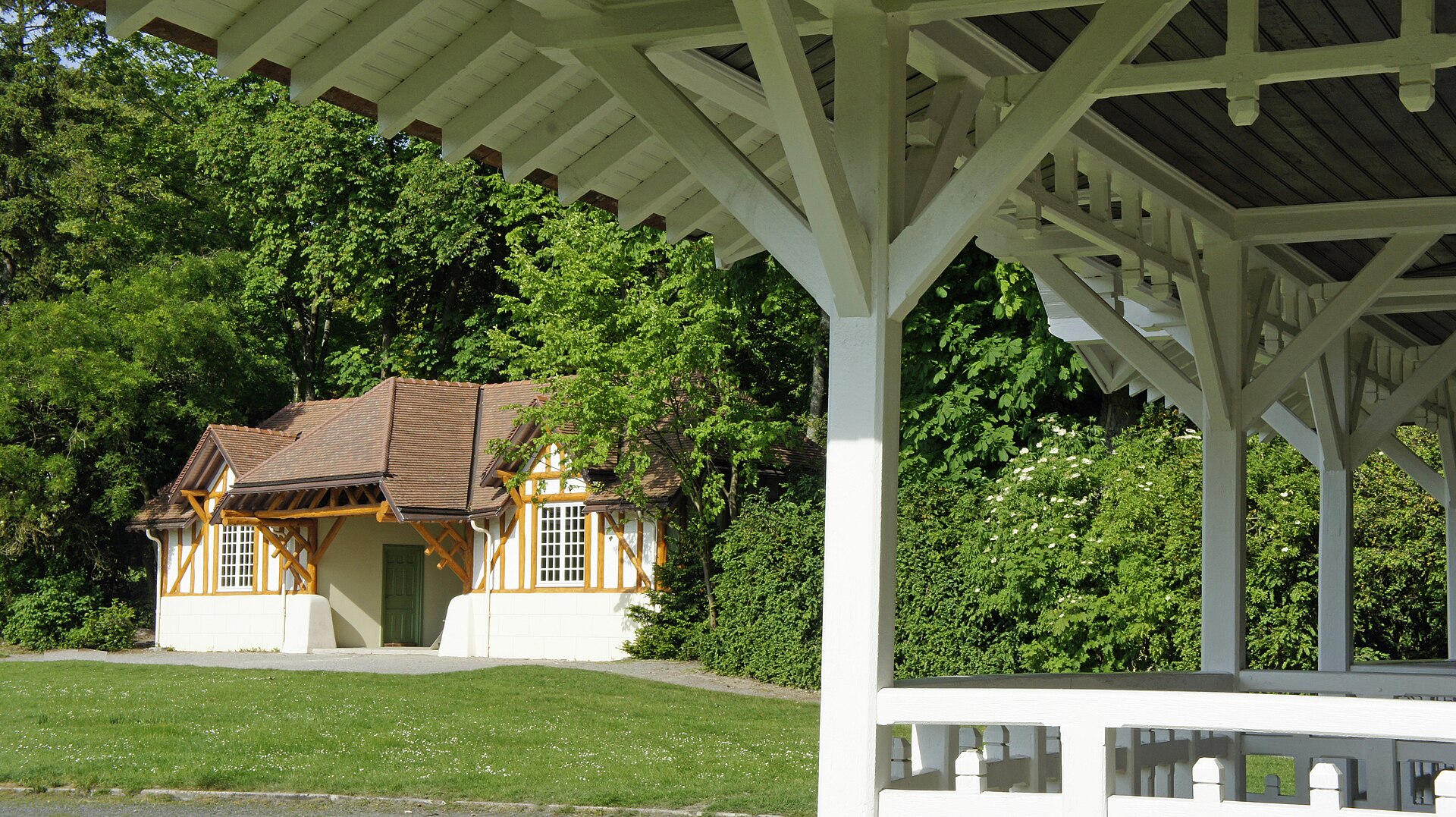
A stele commemorating the Collège d’athlètes. The original entrance pavilion is still standing, but the training buildings are gone.
3,000 trees
The park has around 3,000 trees, most replanted after 1918. Redont had chosen varied species to create changing colours and textures across the seasons. Both wars destroyed many of them, and in 2004 a major cleanup removed diseased or dangerous specimens.
The Baludik app offers a free walking trail to identify trees on site (“À la découverte des arbres du Parc de Champagne”). An interactive tree map is also available on Ma carte IGN.
What you can do there
Sport and leisure
The park has a 400 m athletics track (4 lanes, cinder surface), a fitness trail with 11 wooden stations, an outdoor fitness area, a basketball court, beach soccer, beach volleyball and rugby pitches, a pétanque court, table tennis tables and chess tables. Cycling is not allowed in the park, except for children learning to ride; bike racks are provided in the car park and at the entrance.
For families: a playground, a treetop course and an orienteering trail for children, a book box, picnic tables, open lawns and public toilets. Picnics are allowed; barbecues and drones are not. Dogs are welcome on a lead held by an adult, except in playgrounds, and a fenced dog area lets them run off-lead.
Trails for children
Three trails available year-round at the park entrance:
- Les Aventures de Kle’o (ages 2+): counting, animal recognition
- 60 Minutes Nature (ages 6+): history and nature of the park
- Enigm’o (ages 10+): solve a riddle using clues hidden around the park
Les Flâneries Musicales
Every summer, the park hosts the closing concert of the Flâneries Musicales de Reims, a classical music festival spanning a month between June and July. The final concert is outdoors, with a full orchestra, a giant picnic and fireworks. Gates open at 5:30 PM. Several thousand people attend each year.
Festiv’été
In late August, Festiv’été takes over the park for five days to close out the summer holidays. Free activities for ages 7-17 and families: sports, workshops, games and all sorts of introductory sessions. About thirty local partners take turns each day from 2 PM to 6 PM.
Other events
The park also hosts the Reims International Jumping (show jumping), outdoor photography exhibitions and a simples garden (aromatic and medicinal herbs) planted each year. Some events require temporary park closures.
Practical information
Getting there
Address: 10 avenue du Général Giraud, 51100 Reims.
About 2 km from the city centre, heading southeast. By car, free parking on site. By bus, take line U5 to the “Parc” stop.
Opening hours
7:30 AM to 9 PM from June to September 2026, usually 9 AM to 5 PM in winter, with occasional closures for events and weather warnings: see the detailed opening hours.
On site
- Free entry and free parking
- Picnic tables
- Playground, treetop course and orienteering trail for children
- Fenced dog area
- Dogs on a lead welcome, except in playgrounds
- Public toilets
- No cycling, barbecues or drones
Nearby
The park is in the Champagne Houses quarter. The Pommery, Ruinart, Taittinger and Veuve Clicquot cellars are all within a 10-minute walk. Domaine Les Crayères (palace hotel and starred restaurant) is 400 metres from the entrance.
Frequently asked questions
Cover photo: Garitan / Wikimedia Commons, CC BY-SA 3.0