Saint-Remi Basilica in Reims: what to see and how to visit
At 126 metres long, Saint-Remi Basilica rewards a look down the nave before you move closer to its details. Romanesque arches lead towards a Gothic choir, where the tomb of the bishop who baptised Clovis connects the church with the history of France’s kings. Above it all hangs an enormous crown of light.
You can visit the church for free. Saint-Remi Museum, in the neighbouring former abbey, is a separate attraction with its own admission arrangements. Allow around half an hour for a first look inside the basilica, or longer if you want to study the glass and sculpture.
Practical information for your visit
| Detail | What to know |
|---|---|
| Location | Place Chanoine Ladame, by Rue Simon and Rue Saint-Julien, Reims |
| Independent visits | Free admission |
| Suggested time | Marne tourism gives an average visit length of 30 minutes |
| Opening hours | Confirm with the parish or tourist office for your intended visit, particularly around services |
| Saint-Remi parish | +33 3 26 85 31 20 |
| Reims tourist office | +33 3 26 77 45 00 |
Need to fit the church into a tight schedule? Check the opening hours with the parish first. Seasonal times appear in an older city brochure, but we could not confirm them as a current 2026 timetable. Practical information was checked on 21 October 2026.
For step-free access or a visit with a pushchair, ask about the church itself before travelling. Access information for the museum next door does not automatically apply to the basilica. Find the basilica on OpenStreetMap.
What to look for inside Saint-Remi
Where Romanesque architecture meets the Gothic choir
Start with the long view down the nave. Its Romanesque structure belongs to the 11th-century church. In the 12th century, Abbot Pierre de Celles began a major rebuilding programme, including a new east end with an ambulatory and radiating chapels around the shrine.
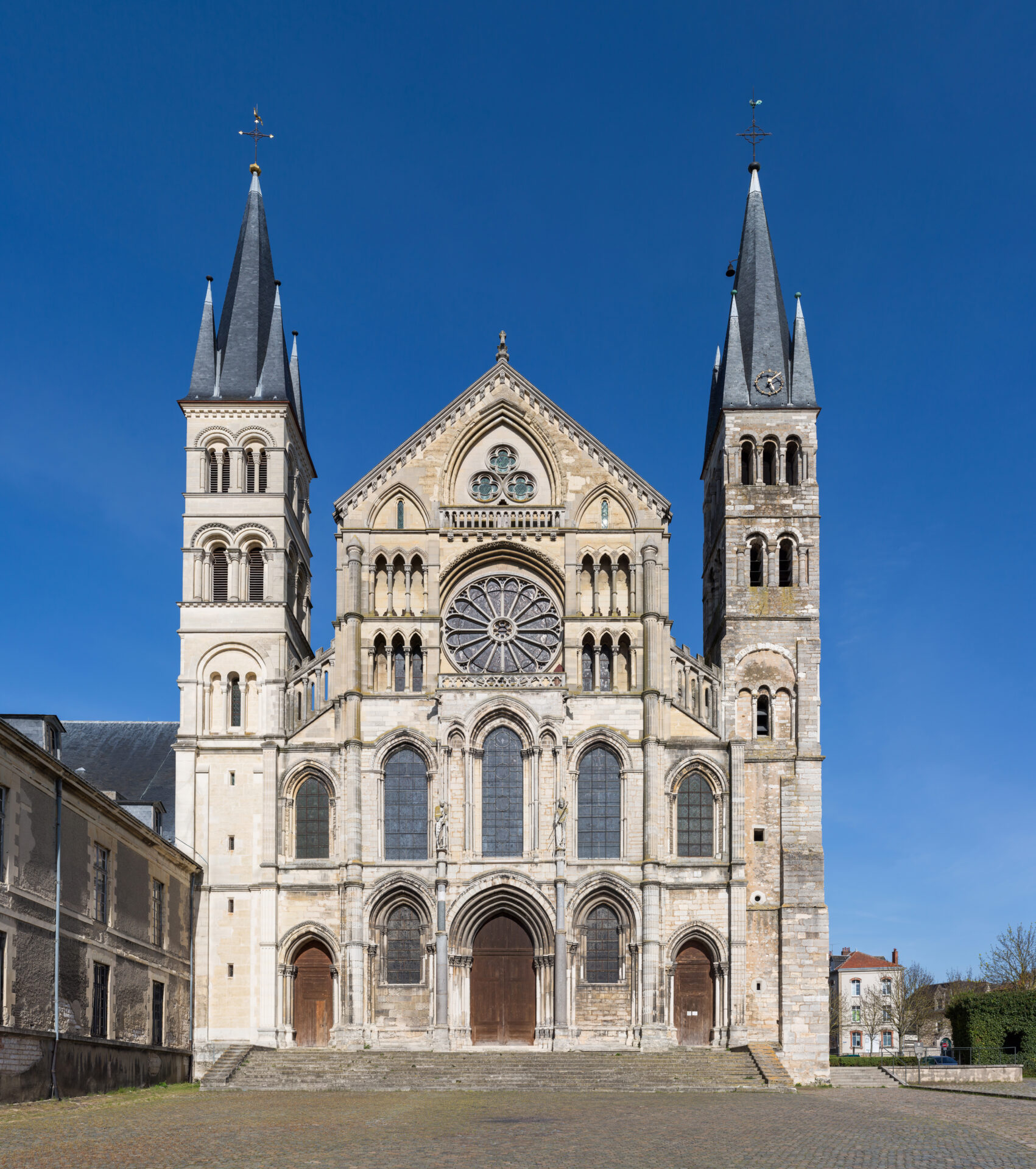
Look at the choir’s four levels, then follow the passage around it: you’re tracing a route that allowed pilgrims to approach the relics while the church continued to function around them, one reason for rebuilding the east end. Outside, compare the façade with its two Romanesque towers. You’ll see Gothic work between them, another reminder that this church took shape in stages.
The tomb and the figures of the coronation ceremony
In the choir you’ll find the present tomb of Saint Remi, dated 1847. Look closer. Some surrounding statues come from an earlier mausoleum, depicting Clovis’s baptism and the peers of France involved in royal coronations, so you’re looking at sculptures reused within a later monument.
What are the figures carrying? You can identify royal regalia with the help of the city’s heritage brochure: the crown and the Holy Ampulla, the vessel associated with anointing oil, connect a bishop’s shrine to the coronation ceremony. You don’t need to know every figure to follow that connection.
The crown of light
At the meeting point of nave and choir, look up. The suspended crown reproduces a medieval example destroyed during the French Revolution. Its twelve towers each carry eight candles, making 96 in total, referring to the Heavenly Jerusalem and the age traditionally attributed to Remi.
The diocese describes a diameter of six metres and says the crown is illuminated on the first Sunday of October, following the Saint-Remi celebrations. Don’t plan a visit expecting a daily candle-lighting display. The structure is worth looking at even when the candles are unlit.
Stained glass, medieval tiles and the organ
If you enjoy stained glass, start with the choir’s 12th-century windows, where you’ll find the Virgin Mary, apostles and figures from Reims’s religious history, before comparing them with the modern work in the nave: windows made between 1950 and 1980 by the Simon-Marq workshop. The difference is worth a pause.
In the left aisle, look for the displayed floor tiles mentioned in the city brochure. They came from Saint-Nicaise Abbey, which was destroyed during the Revolution, and depict Old Testament scenes. Easy to walk past, they preserve something of another major religious building that Reims has lost.
Bernard Cattiaux made the present organ. Its position in the nave reflects acoustic choices as well as the constraints of a protected historic building: installing an instrument here involved finding a place that suited both the sound and the church. Want to hear it? Check parish or concert announcements. An ordinary sightseeing visit offers a view of the instrument, without a performance being guaranteed.
Saint Remi, Clovis and the history of Reims
Remi was the bishop of Reims who baptised Clovis in the late 5th century. After his death, his relics attracted pilgrims. An early oratory was enlarged, a Benedictine community settled here in the 8th century, and the Romanesque church followed in the 11th.
That chronology matters. You’re visiting a church built centuries after Clovis’s baptism. Its connection with him comes through Remi and the cult surrounding the bishop’s relics, while the later Gothic alterations show how the building adapted as pilgrimage grew and more people needed to move around the shrine.
The First World War caused extensive damage. Following fire and destruction, the south side of the nave collapsed in 1919. Restoration continued for decades, until 1958 according to Marne tourism. Repairs and newer stained glass are part of the building’s story, rather than evidence of an interior left untouched since the Middle Ages.
In 1991, the cathedral, former Abbey of Saint-Remi and Palace of Tau were inscribed together on UNESCO’s World Heritage List. The grouping reflects their connected roles in the history of French monarchy and coronation.
The Holy Ampulla: legend and royal ritual
The basilica and abbey were associated with the Holy Ampulla, or Sainte Ampoule, the vessel used in the tradition of anointing French kings. According to legend, a dove brought the holy oil at the baptism of Clovis. The city brochure presents that story as a legend, alongside the history of the cult.
Before a coronation, the vessel was taken from the abbey to the cathedral. It was broken during the French Revolution. So don’t come expecting to see an ancient flask preserved intact from Clovis’s baptism: the visit is about Remi’s shrine, the royal ritual and the objects that recall it.
Our guide to when Reims Cathedral was built follows the history of the other great church involved in this tradition. The buildings belong to different periods, but the coronation ceremony linked them.
Visiting the basilica and the museum separately
For Saint-Remi Museum, head to the former abbey at 53 Rue Simon. There you can explore collections about Reims and the surrounding region. Planning to see both? You’ll need to check museum opening times, tickets and access arrangements separately, since the basilica remains a working church.
If you have half an hour, concentrate on the church. With more time, add the museum as another visit rather than treating it as an extra room of the basilica. Our Reims museum guide helps you choose, while things to do in Reims places Saint-Remi within a wider stay.
Services and ceremonies take priority in the church. If one is taking place, adjust your visit and choose another time for walking around the interior.