15 Things to do in Reims: Champagne, Cathedral, and History
Reims sits 130 km northeast of Paris, close enough for a day trip yet rich enough to deserve two or three days. Often called the Champagne capital of France, this is where 33 French kings were crowned, where some of the world’s best wine ages in chalk cellars, and where Art Nouveau and Art Deco buildings line wide boulevards rebuilt after the First World War. Whether you arrive by TGV from Paris or drive through the Champagne vineyards, Reims is a great place to visit for anyone drawn to medieval grandeur, world-class Champagne, and a walkable city center. Here are the best things to do when you visit.
Getting to Reims
The fastest way to reach Reims from Paris is the TGV, which covers the distance in about 45 minutes from Gare de l’Est. Trains run roughly every hour, making Reims one of the easiest day trips from Paris. By car, take the A4 motorway (about 90 minutes depending on traffic). Once in the city, most sights are within walking distance of each other in the compact center. Buses and the tramway (CITURA network) cover everything else.
1. Notre-Dame de Reims Cathedral
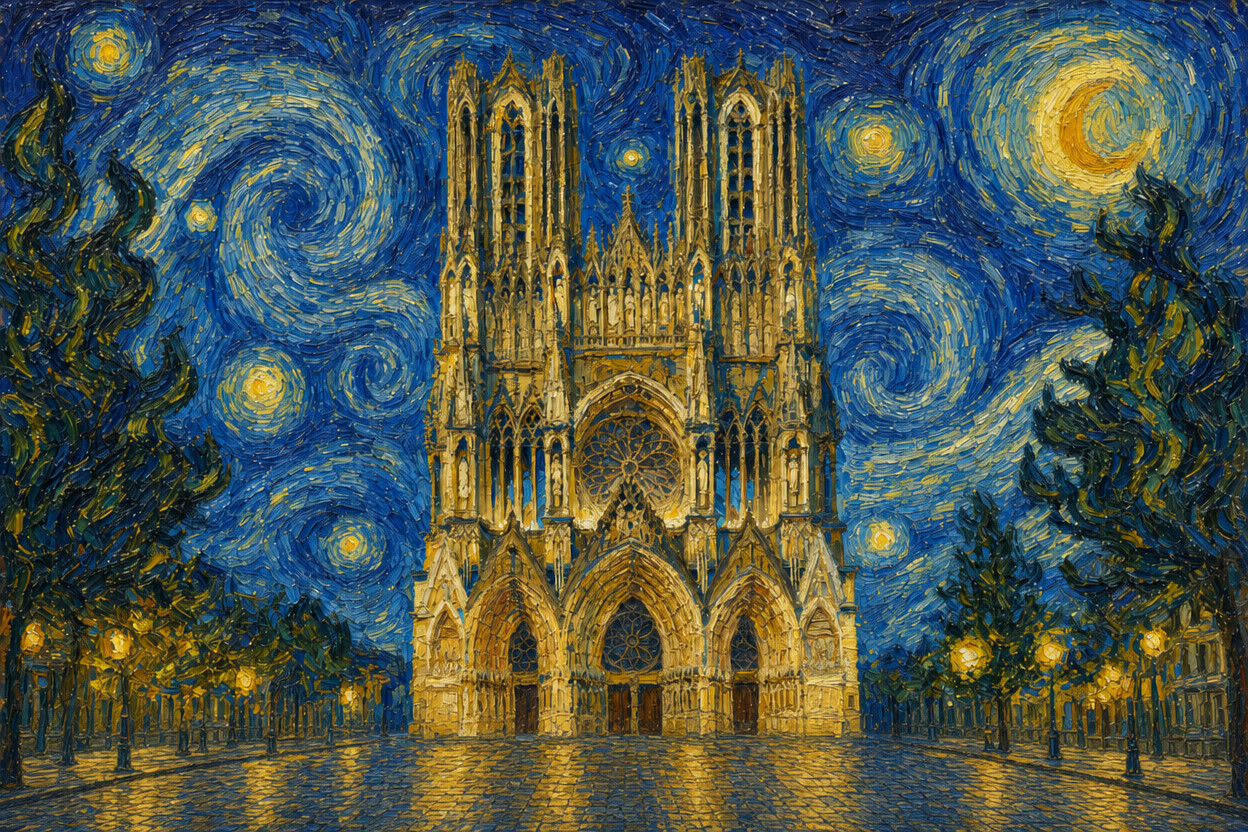
Notre-Dame de Reims is the cathedral in Reims where French kings were crowned for over 800 years, from Clovis I in 496 AD to Charles X in 1825. This 13th-century Gothic masterpiece is a UNESCO World Heritage Site, covered in more than 2,300 sculpted figures on its facade alone. Inside, look up: the stained glass windows by Marc Chagall in the apse chapel glow with deep blues that are unlike anything else in France. The western rose window, over 12 meters wide, floods the nave with light on sunny afternoons.
The cathedral is free to enter and open daily. Allow at least 45 minutes. On summer evenings, a light show projected onto the facade recreates the original medieval colors of the sculptures.
2. Palais du Tau
Right next to Notre Dame, the Palais du Tau served as the residence of archbishops and later as the place where kings stayed before and after their coronation. Today it is a museum housing royal treasures: the 9th-century talisman of Charlemagne, ceremonial robes, and monumental tapestries. Several original statues from the facade, removed for conservation, are displayed here at eye level, letting you appreciate details invisible from the ground.
3. Basilica of Saint-Rémi
This 11th-century abbey church, also a UNESCO World Heritage Site, predates Notre-Dame by two centuries. It holds the relics of Saint Rémi, who baptized Clovis and gave Reims its role in the coronation tradition. The building blends Romanesque columns and arches with later Gothic vaults, and the 12th-century stained glass choir windows are among the oldest in the Champagne region. The atmosphere here is quieter and more contemplative, and the walk from the center of Reims takes about 15 minutes.
4. Champagne Houses in Reims
Reims is the unofficial capital of the Champagne region, and many Champagne houses offer cellar tours just south of the city center. The chalk caves and tunnels underneath Reims, carved out as far back as Roman times, provide the perfect cool, humid conditions for aging Champagne in Reims. A cellar visit typically lasts 60 to 90 minutes and ends with a glass of Champagne (or two).
The major Champagne houses you can visit in Reims include Veuve Clicquot, Pommery, Taittinger, Ruinart (the oldest Champagne house, founded in 1729), and Mumm. Each has a different character: Pommery’s cellars are spectacular for their carved limestone galleries and contemporary art installations; Veuve Clicquot’s tour traces the story of Madame Clicquot herself; Taittinger takes you through former Benedictine abbey cellars. Booking ahead is recommended, especially during summer.
5. Villa Demoiselle
On boulevard Henri-Vasnier, near the Champagne Pommery estate, Villa Demoiselle is one of the finest examples of Art Nouveau and Art Deco architecture in northern France. Built between 1904 and 1908 by architect Louis Sorel for Louise Pommery, the villa was restored by the Vranken-Pommery group and opened to the public. Inside you will find furniture by Majorelle, wrought ironwork by Emile Robert, and stained glass that shifts between floral Art Nouveau curves and geometric Art Deco lines. The villa belongs to Vranken Pommery and can be visited on Sundays from 12:00 to 17:00 or by appointment. It is a short walk from the cathedral area, and anyone who has visited Reims for the Champagne cellars should make time for this stop.
6. Musée de la Reddition (Museum of the Surrender)
On 7 May 1945 at 2:41 AM, the German High Command signed the unconditional surrender that ended the Second World War in Europe. That signing took place in a schoolroom at 12 rue Franklin Roosevelt in Reims, and the room has been preserved exactly as it was that night: maps pinned to the walls, the long table with its chairs, and the original documents. The museum around it covers the final months of the war through photographs, uniforms, and film footage. A visit takes about 45 minutes and offers a perspective on the First and Second World Wars that you will not find anywhere else.
7. Porte de Mars
This 3rd-century Roman triumphal arch, 33 meters long, is one of the widest surviving Roman arches anywhere. It originally marked the northern entrance to the city and carried carved reliefs depicting scenes of daily life, agriculture, and mythology. The Porte de Mars stood half-buried for centuries and was only fully uncovered in the 1800s. It sits in a small park near the train station, making it an easy first stop when arriving in Reims.
8. Museum of Fine Arts
Housed in the former abbey of Saint-Denis, the Musée des Beaux-Arts holds works spanning five centuries: Cranach, David, Delacroix, Renoir, Matisse, Monet, and a strong collection of 19th-century Barbizon landscapes by Corot. The museum was established after the French Revolution with artworks seized from aristocratic collections and has grown steadily since. It reopened in 2025 after extensive renovations and is worth a visit for its setting alone, with high-ceilinged rooms overlooking an inner courtyard. For a complete guide, see our article on the best museums in Reims.
9. Place Royale and the City Center
Place Royale is an elegant 18th-century square with a statue of Louis XV at its center, placed here in 1818 to replace an earlier one destroyed during the Revolution. Walk from the cathedral toward Place Drouet d’Erlon, the main boulevard of Reims, lined with cafés, brasseries, and shops. For a caffeine break, check out the best local coffee shops in Reims. The city center rewards aimless wandering: Art Deco facades from the 1920s reconstruction sit next to medieval half-timbered houses that survived the wars. Reims is a place to visit at your own pace, and nearly every block reveals something worth a closer look.
10. Art Deco Carnegie Library
After Reims was devastated in the First World War, Andrew Carnegie funded the construction of a new public library, completed in 1928. The building is a showcase of Art Deco design: geometric tiled floors, stained glass accents, curved wooden furniture, and wrought iron details. It is still a working library today, and you can walk in free of charge to admire the reading rooms. The exterior, with its clean lines and decorative reliefs, is one of the most photographed facades in Reims.
11. Musée Hôtel Le Vergeur
This museum occupies a 16th-century merchant’s mansion with a Renaissance courtyard that survived the destruction of World War I. Inside, rooms furnished in period style hold Gothic and Renaissance art, along with a rare set of engravings by Albrecht Dürer. The guided tour is the only way to see the interior, but the courtyard is freely accessible and gives a sense of what Reims looked like before the wars reshaped it.
12. Saint-Rémi History Museum
Housed in the former royal abbey next to the Basilica of Saint-Rémi, this museum traces the history of Reims from prehistoric times through the Renaissance. Its 17 exhibit rooms contain Gallo-Roman mosaics, medieval weapons, and objects that document the city’s development from a Celtic settlement to a Roman colony to the place where kings were crowned. The cloister and grand staircase of the abbey are highlights in themselves.
13. Champagne Vineyards Around Reims
The hillsides around Reims, particularly the Montagne de Reims between the city and Epernay, are planted with Pinot Noir grapes and classified as UNESCO World Heritage. Several small producers welcome visitors for tastings, and the GR de Pays hiking trail winds through the vineyards with views over the plain. You can drive, cycle, or join one of the many Reims tours that visit two or three producers in a morning. The villages of Verzenay (with its lighthouse-shaped museum perched among the vines) and Bouzy are good starting points. A visit to Reims is not complete without seeing where the grapes actually grow.
14. Épernay and the Avenue de Champagne
Thirty minutes south of Reims by car or train, Epernay is the other capital of the Champagne region. The Avenue de Champagne, a UNESCO-listed street, is lined with the headquarters and cellars of Moët & Chandon, Perrier-Jouët, Mercier, and other houses. Beneath the avenue lie over 100 km of underground galleries filled with bottles. A visit to Epernay pairs well with a morning in the vineyards: drive through the scenic Route du Champagne, stop for tastings, then finish the day at a cellar on the avenue.
15. Automobile Museum
For a change of pace, the Musée Automobile Reims-Champagne displays over 250 vehicles dating from 1908 to the present, including rare French marques like Dillard, Salmson, and Amilcar. The collection also covers the history of motor racing around Reims, including the legendary Reims-Gueux circuit that hosted Formula 1 Grand Prix races until 1966. A niche interest, but worth a stop for anyone curious about the region’s automotive heritage.
Where to Stay in Reims
Reims is compact, and staying near the cathedral or Place Drouet d’Erlon puts you within walking distance of everything. Most visitors find that two full days is the right amount of time to cover the main sights at a relaxed pace, with time for a Champagne cellar tour and a meal at one of the city’s restaurants. If you are using Reims as a base for exploring the vineyards and Épernay, three days is ideal.
The Reims City Pass
The Reims City Pass covers admission to the main museums and monuments, cellar tours at several Champagne houses (Veuve Clicquot, Pommery, Ruinart, Taittinger, and others), and unlimited use of the CITURA bus and tram network. It comes in 24-hour (€18), 48-hour (€24), and 72-hour (€30) versions. Pick it up at the Tourist Office or buy it online. If you plan to visit at least two museums and one Champagne house, the pass pays for itself.