Reims-Gueux Circuit: History, Visitor Guide and Centenary
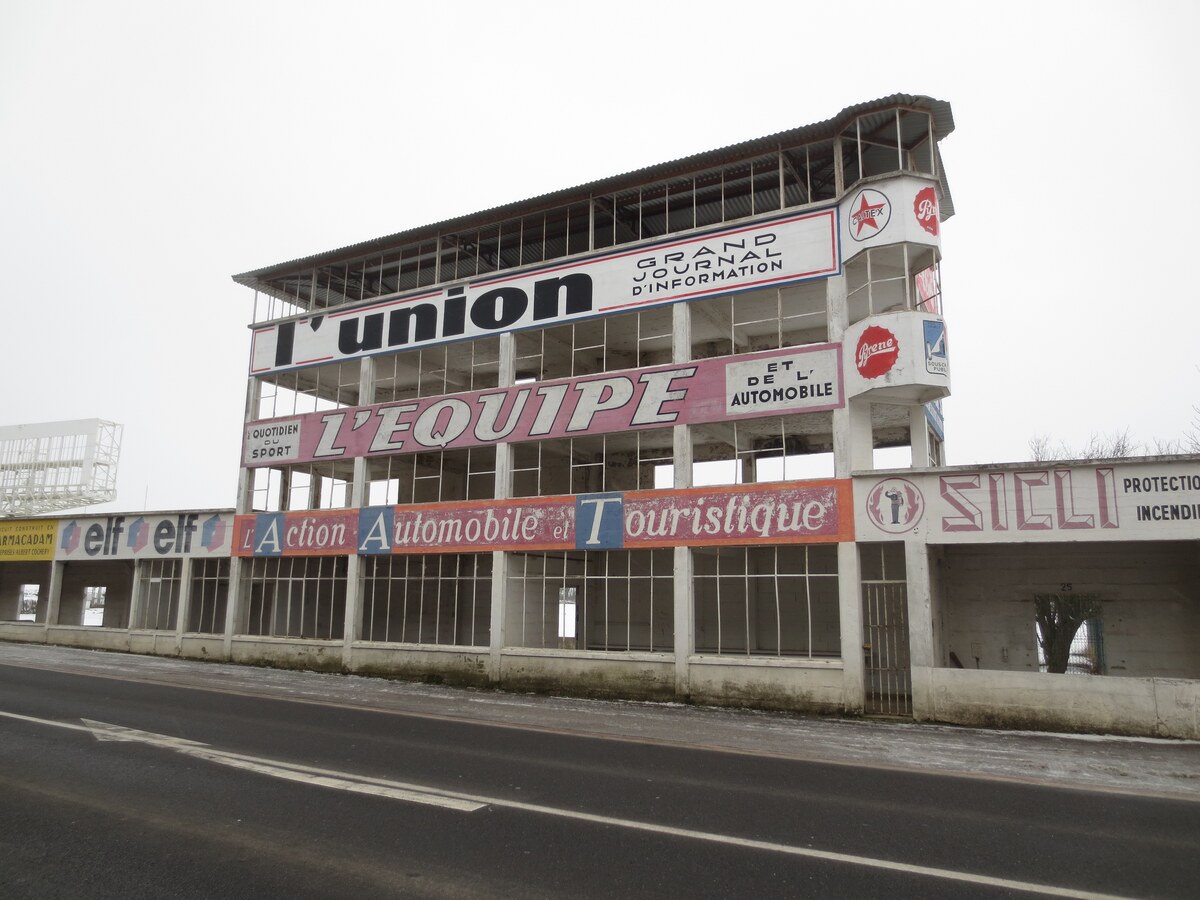
Seven kilometres west of Reims, between Gueux and Thillois, historic pit buildings and grandstands still line a public road. These are the remains of the Reims-Gueux circuit, which operated from 1926 to 1972. It hosted 14 French Grands Prix, including 11 rounds of the Formula 1 World Championship.
Part of the site has been protected as a French historic monument since 2009. Its centenary festival, held in September 2026, attracted 6,000 visitors and 350 historic vehicles. This guide covers both the story of the circuit and the practical details you need for a visit. If you are also exploring the city, see our guide to the best things to do in Reims.
A racing circuit born on country roads (1926)
On 2 August 1925, the Automobile Club de Champagne organised the first Grand Prix de la Marne on a 21 km course around the village of Beine-Nauroy, east of the city. The race worked, but logistics proved difficult.
The following year, the organisers moved the race closer to Reims. On 25 July 1926, the triangle formed by the RN31, CD 26 and CD 27 between Thillois and Gueux opened. François Lescot won the Grand Prix de la Marne in a Bugatti 35 at an average of 112.768 km/h. The first 12 Hours of Reims followed on 22 August 1926, not that same evening. The original course measured 7.816 km.
In 1932, the Automobile Club de France held its Grand Prix at Gueux for the first time. Tazio Nuvolari won the race.
The French Grand Prix returned in 1938, when Mercedes-Benz dominated and Manfred von Brauchitsch won. Racing stopped during the war and resumed at Reims in 1947.
The first grands prix of the World Championship (1950-1953)
On 2 July 1950, Reims-Gueux hosted the 6th round of the very first Formula 1 World Championship. Juan Manuel Fangio, driving an Alfa Romeo Alfetta, took pole position at 186.8 km/h and won ahead of Fagioli and Whitehead.
The connection between Champagne and motor racing was already well established. From 1925, Champagne houses supported races around Reims and offered a jeroboam to the winner. Presenting a bottle predates the much later custom of spraying it on the podium.
In 1952, a southern bypass was built to avoid the village of Gueux for safety reasons. The course was shortened to 7.198 km. It was on this reduced layout that Jean Behra drove Gordini to victory in the Grand Prix de la Marne. In 1953, the northern bypass extended the length to 8.347 km, with five corners instead of three.
The “Race of the Century” (5 July 1953)
The 1953 French Grand Prix is remembered for its close finish. Mike Hawthorn, aged 24, beat Juan Manuel Fangio by exactly one second after 60 laps and 500 km. González finished 1.4 seconds behind and Ascari 4.6 seconds behind, so the first four were covered by less than five seconds. Farina, in fifth place, finished more than a minute later. Hawthorn became the first British winner of a World Championship Grand Prix.
The golden age of motor racing (1954-1961)
In 1954, a modification at Thillois set the final length at 8.301 km. It would remain unchanged until the closure. The course consisted of the RN 31 (pit straight), the CD 26 (the long Gueux straight) and the CD 27, forming a fast triangle where single-seaters exceeded 250 km/h.
The return of Mercedes-Benz (4 July 1954)
The 1954 French Grand Prix marked the return of Mercedes-Benz to racing after fifteen years away. Three W196 R Streamliners, with their streamlined bodywork, made their competition debut. Fangio won ahead of Karl Kling by 0.1 seconds. It was the German manufacturer’s first official Formula 1 victory.
The long straights suited powerful cars. Teams tested aerodynamic solutions that no other circuit allowed them to exploit. Fangio returned to win in 1951 and 1954; he drove his last race at Reims in 1958, aged 47.
In 1961, Giancarlo Baghetti beat Dan Gurney by just 0.1 seconds in a Ferrari 156. He won on his World Championship debut.
The price of speed: the tragedies of motorsport
Reims-Gueux was exceptionally fast, while its protection remained that of a public-road circuit of its era.
On 30 June 1956, Annie Bousquet died during the 12 Hours of Reims near Muizon. The corner was later named after her. Two drivers were killed during the 1957 Coupe de Vitesse, and Luigi Musso died during the 1958 French Grand Prix.
The crash that seriously injured Jean-Pierre Beltoise in 1964 also showed the growing gap between racing speeds and the protection offered by roads bordered by banks, houses and fields.
The decline of a legendary circuit (1966-1972)
On 3 July 1966, Jack Brabham won in a Brabham BT19-Repco: the first driver-constructor to win in Formula 1. Lorenzo Bandini took pole at 233.8 km/h. It was the last grand prix at Reims-Gueux. The top tier of motorsport would not return.
Safety standards were evolving. The venue, laid out on open roads, could not be brought up to the standards required by the international federation. The cost of upgrades was prohibitive.
In 1969, the last motor racing meeting featured F2, F3, R8 Gordini Cup and FFSA Critérium races. François Cevert won the F2 event. Six cars finished within half a second of each other.
On 11 June 1972, a motorcycle race was the last competition held at the site. The roads became ordinary roads again. The closure resulted from two insurmountable problems: non-compliant safety standards and financial difficulties.
What remains: the circuit’s surviving structures
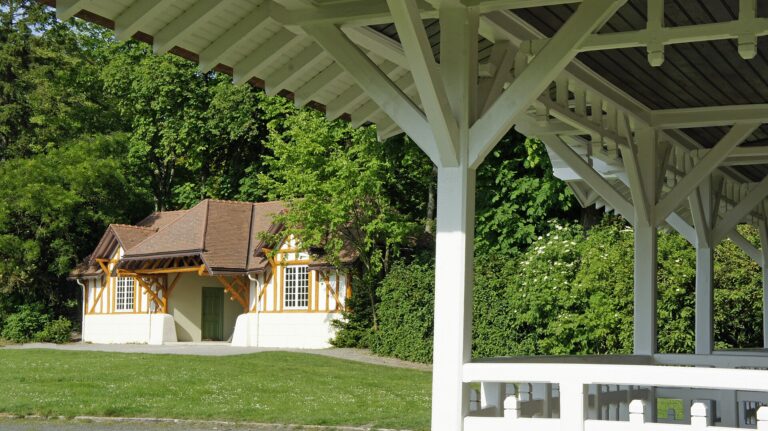
The pits, grandstands, Lambert timing pavilion and restaurant tower remain visible. They were built in stages from the late 1920s through the 1950s. Their position beside the D 27 is what makes a visit so unusual.
Parts of the old layout can still be followed on present-day roads. They are open to normal traffic and do not form a closed circuit. French traffic rules apply, and visitors should park only where it is permitted.
Since the decree of 7 May 2009, part of the site has been listed as a French historic monument (inscrit au titre des monuments historiques). Protected elements include several grandstands, the pits and central pavilion, the Lambert pavilion, the underpass, the rotating scoreboard and the fuel-tank support.
Bringing the circuit back to life: the associations
Two associations have successively managed the site. The Amis du Circuit de Gueux (Friends of the Gueux Circuit), founded in 2007, spent 17 years restoring, maintaining and running events at the venue with dedicated volunteers. They offer a free audio guide (in French and English) available on their website.
In February 2024, the municipality of Gueux handed management to a new association: Circuit Reims Gueux Passion Légende (also known as “Les passionnés du Circuit de la Marne”). The handover was debated locally, but both organisations share the same goal: to preserve this unique motorsport heritage and bring this historic venue back to life.
The Fondation du patrimoine supports work on the restaurant tower. Its official fundraising page sets a target of EUR 75,000 for the trackside restaurant windows and facades. On 17 October 2026, it showed EUR 72,335 raised, or 96% of the target. Check that page for the latest progress.
The 2026 centenary: 6,000 visitors
On 12 and 13 September 2026, a festival marked 100 years since the first race on the Gueux layout. The published review reported 6,000 visitors and 350 historic vehicles.
The programme combined displays, demonstration runs, a concours d’élégance and a final parade around the historic route.
For future gatherings, check the organising association’s current schedule. Dates and access conditions can change.
Visiting the Reims-Gueux circuit: practical information
Getting there
The site is located on the RD 27, between Gueux and Thillois, 7 km west of the city centre. By car, take the Gueux exit from the A4 motorway or follow the D 26. The buildings are visible from the road.
Free parking on site.
Opening hours and admission
The Reims tourist office describes the outdoor visit as free and self-guided, with group visits available on request. Not every building is open to the public, so follow any barriers and signs you find on the day. The Amis du Circuit de Gueux offer an audio guide in French and English.
Driving the former circuit
Parts of the old course use the D 27, D 26 and former N31. You can trace its shape by car, but these are public roads carrying normal traffic. Follow your navigation app, obey speed limits and do not stop in the carriageway for photographs.
Frequently Asked Questions
Verified sources
Cover photo: Paul.schrepfer / Wikimedia Commons, CC BY-SA 4.0