When Was Reims Cathedral Built?
When was Reims Cathedral built? Construction began in 1211 and the last stone was laid in 1515, but the main structure was essentially completed in about 60 years. The cathedral we see today replaced an earlier one that burned down on May 6, 1210, along with much of the city. Over three centuries, four master builders shaped the building into what is now the longest cathedral in France and one of the finest examples of Gothic architecture in Europe.
Before the Gothic Cathedral
The site has been a place of worship since late antiquity. In 401, Bishop Nicasius (later Saint Nicasius) founded the first cathedral, Notre-Dame, on the remains of ancient Roman thermae. This was nearly a century before the baptism of Clovis, which took place around 496. The early church established Reims as a religious center, and the baptism of the Frankish king cemented the city’s role in French royal tradition.
A Carolingian cathedral replaced the earlier building in 820. It was consecrated in 862 in the presence of Charles the Bald. That structure served Reims for nearly four centuries, hosting coronations and growing in prestige alongside the archbishops who governed a vast territory across northern France. By the 8th century, the Bishop of Reims had taken the title of Archbishop and held authority over bishoprics including Laon, Soissons, Senlis, Amiens, and Cambrai.
On May 6, 1210, fire swept through Reims and destroyed the Carolingian cathedral. The archbishop and clergy began planning a replacement immediately.
The Four Master Builders
Archbishop Aubry de Humbert ordered construction in 1211. Over the following decades, four master masons directed the work in succession. We know their names because they were recorded in a floor labyrinth installed in the nave, between the third and fourth bays. The labyrinth was destroyed in 1778 by the cathedral’s chapter, who found the noise of children playing on it during services intolerable. But drawings made before its removal preserved the names.
The four builders were Jean d’Orbais, who began with the chevet and apse; Jean-le-Loup, who continued work on the nave; Gaucher de Reims, who handled the portals and upper levels; and Bernard de Soissons, who completed the western facade and the great rose window. Each brought a slightly different approach to the Gothic style, yet the cathedral reads as a unified design. That consistency across generations of builders is one of the things that sets Reims apart from cathedrals like Chartres or Bourges, where shifts in style are more visible.
The labyrinth itself left one lasting mark. Its graphic representation, rotated 45 degrees, is used today as the official logo designating French buildings listed as historical monuments.
Construction Timeline
Progress was fast at first. By 1220-1221, the Rayonnant chapels and the ambulatory were finished. Ten years from first stone to completed east end. Between 1220 and 1233, workers built the transept, the double aisles, and the five eastern bays of the nave aisles. Services continued in the old, narrower nave while the new walls rose around it.
Then the money ran out. In 1233, the people of Reims revolted against the cost of construction. The suffragan bishops, including the Bishop of Laon, protested the forced collection of funds. The cathedral chapter abandoned the city for more than two years. It took the joint intervention of Pope Gregory IX and King Louis IX (Saint Louis) to restore order and restart the work.
The revolt had lasting consequences. The original plan called for seven spires. That was scaled back permanently. The double aisles planned for the nave were dropped. Side chapels in the buttresses were abandoned. What was built is still enormous, but it is a reduced version of what the first architects had drawn.
Around 1245, the new western facade rose more than 20 meters beyond the old one. By 1252, the portals reached the height of the gables. The two towers took much longer, not reaching completion until the first half of the 15th century. A roof fire on July 24, 1481 set things back again; repairs lasted nine years. The last stone was laid in 1515, and work on the spires stopped in 1516 when a royal grant financing that portion of the construction came to an end. The spires were never completed.
The Cathedral in Numbers
Reims Cathedral was designed to hold the massive crowds that attended coronations. The numbers reflect that ambition:
Total length: 149.17 m, longer than Amiens (145 m) and Notre-Dame de Paris (130 m). Nave height: 38 m. Tower height: 81.50 m, though the original design called for 120 m. Floor area: 6,650 m². The great western rose window measures 12.5 m in diameter. There are 80 windows and 4 rose windows, with a total glazed surface of 3,900 m², of which 1,500 m² is in color.
The facade carries 2,302 statues, more than any other cathedral in France. Of those, 211 are tall figures standing 3 to 4 meters high, 788 depict animals, and 191 figures plus 50 animals are inside the building. Add 88 gargoyles to the count. In 1861, a local priest named Tourneur documented every one of them.
Twenty-five kings of France were crowned here, from Louis VIII in 1223 to Charles X in 1825.
The Smiling Angel
Among those 2,302 statues, one became the symbol of the entire city. The Smiling Angel (L’Ange au Sourire) was carved between 1236 and 1245 and stands on the left side of the north portal, near the statue of Saint Nicaise.
On September 19, 1914, when German shells set the cathedral’s wooden scaffolding on fire, a burning beam fell and decapitated the angel. The head shattered on the ground below. In newspapers across France and beyond, the broken Smiling Angel became the image of what was called the “martyred cathedral,” proof of cultural destruction.
After the war, sculptors reconstructed the figure using original fragments and a plaster casting that had been preserved at the Museum of French Monuments in the Palais du Trocadero in Paris. The restored angel returned to its place on February 13, 1926.
Destruction and Rebirth in the 20th Century
The shelling of September 19, 1914 was only the beginning. Twenty-five German shells hit the cathedral that day. The wooden scaffolding that was in place for routine repairs caught fire. The lead roof melted, and molten metal flowed down through the gargoyles onto the stone below. Over the following four years, the cathedral was hit repeatedly. By the end of the war, much of the roof was gone and stonework was badly damaged.
Both sides used the cathedral for propaganda. The French printed postcards and posters showing the burning ruin. The Germans countered that the French had been using the towers as an artillery observation post, which would have made the cathedral a legitimate military target under international law. The debate has never been fully settled.
In 1919, U.S. President Woodrow Wilson visited the ruins. In 1924, American industrialist John D. Rockefeller donated one million dollars toward restoration, funding work on Reims Cathedral along with the palaces of Fontainebleau and Versailles. The cathedral reopened for worship in 1938.
On July 8, 1962, French President Charles de Gaulle and German Chancellor Konrad Adenauer attended a reconciliation ceremony inside the cathedral. Given everything the building had been through since 1914, the choice of location was deliberate.
In 1974, artist Marc Chagall designed three stained glass windows for the axial chapel: the Tree of Jesse, the two testaments, and the finest hours of Reims. The deep blue light they cast is unlike anything else in the cathedral. In 1991, Reims Cathedral was inscribed as a UNESCO World Heritage Site. Pope John Paul II visited in 1996 for the 1,500th anniversary of Clovis’s baptism, and the cathedral celebrated its 800th anniversary in 2011.
Visiting Reims Cathedral Today
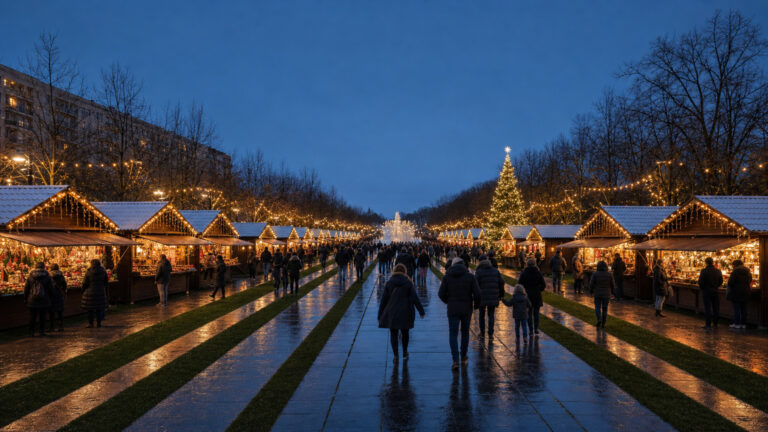
The cathedral is free to enter and open daily from 7:30 AM to 7:30 PM (7:15 PM on Sundays and holidays). Visitors are not admitted during Sunday morning masses from 9 AM to 12 PM. Tower visits, managed by the Centre des Monuments Nationaux, take you up 249 steps to a height of 83 meters. On summer evenings, a light show called “Rêves de Couleurs” is projected onto the western facade, recreating the painted colors that once covered the stone. Over the festive season, the Regalia show is projected onto the facade on Fridays and Saturdays at 8 PM, from 27 November 2026 to 2 January 2027, except 12 December (schedule in our guide to the Reims Christmas Market).
The cathedral is one of the highlights of any visit to Reims. For more ideas, see our guide to the best things to do in Reims.